plis/replis
"The Baroque refers not to an essence but rather to an operative function, to a trait. It endlessly produces folds. [...] the Baroque trait twists and turns its folds, pushing them to infinity, folds over folds, one upon the other. The Baroque fold unfurls all the way to infinity [...] moving along two infinities, as if infinity were composed of two stages or floors: the pleats of matter and the folds in the soul. [...] a great Baroque montage that moves between the lower floor, pierced with windows, and the upper floor, blind, and closed, but on the other hand resonating as if it were a musical salon translating the visible movements below into sounds up above." A 'cryptographer' is needed, someone who can at once account for nature and decipher the soul, who can peer into the crannies of matter and read into the folds of the soul. -Gilles Deleuze from “The Fold: Leibniz and the Baroque”, 1992 [“Le Pli: Leibniz et le Baroque”, 1988]
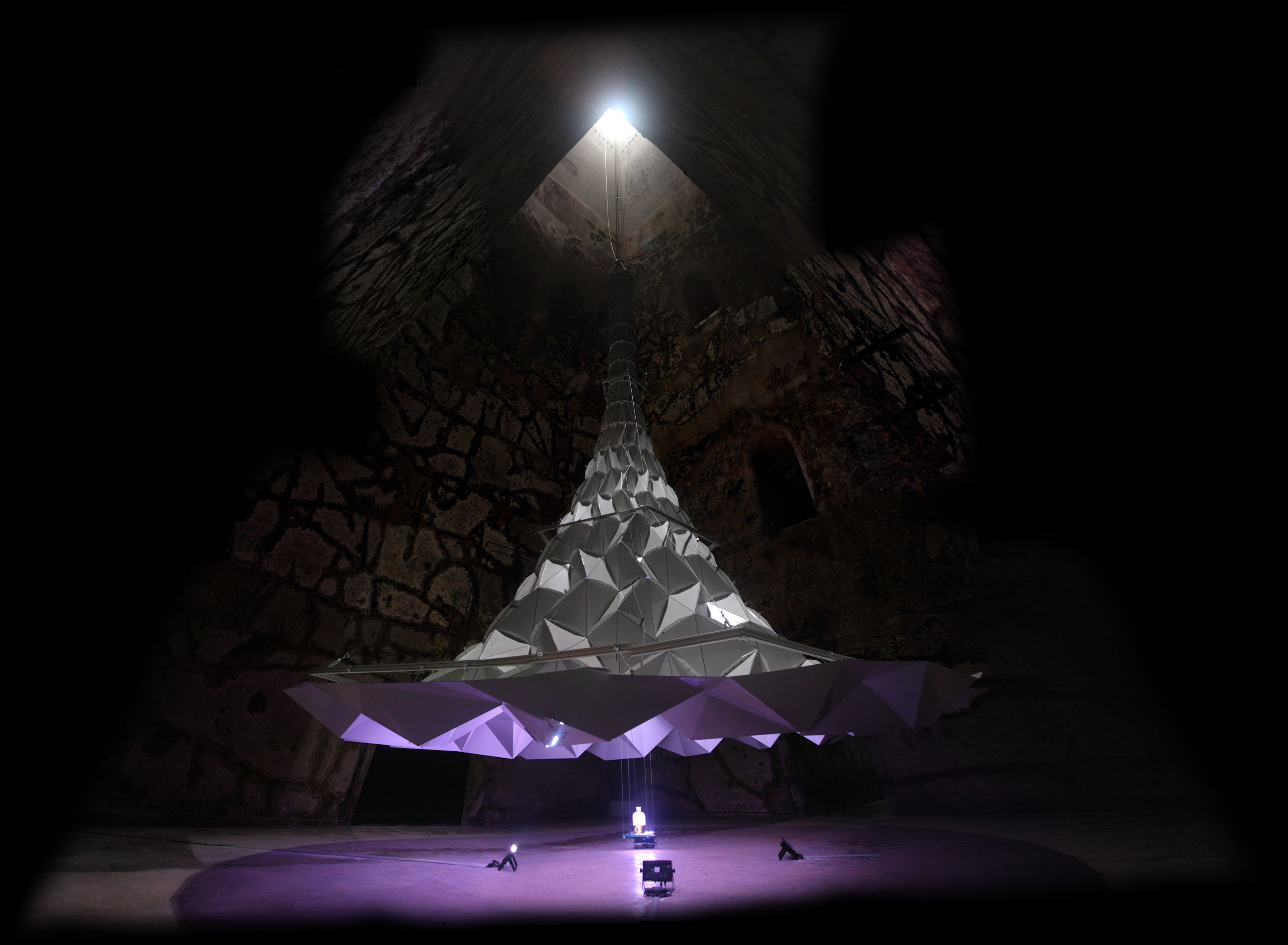
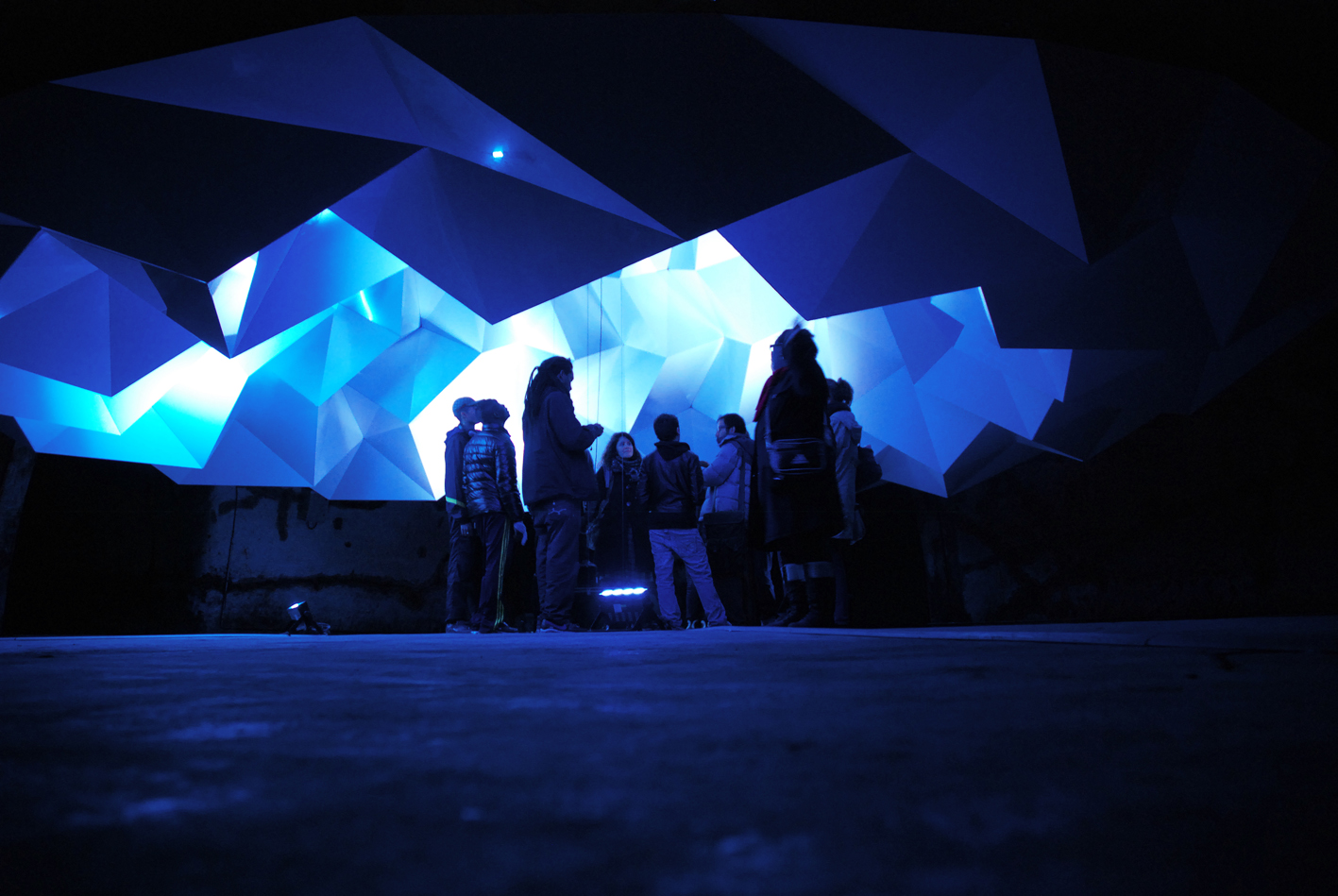
The architectural design of this work combines ancient paper folding techniques with contemporary computer-aided-design and manufacturing processes. The form is inspired by mathematician and origami expert Taketoshi Nojima, especially his work reproducing organic forms from folded paper. Our collaboration with architect Hyoung-Gul Kook allowed us to design, fabricate and assemble this suspended 345 cubic-meter structure from 285 flat sheets of aluminum/polyethylene composite, precisely folded 2,535 times. This structure acoustically amplifies the sound from a single speaker-driver in order to create an enclosed space that bathes the listener in its center in sound.
Dec. 14, 2011: plis/replis was written up in this article on archdaily.com. May, 2012: A poster on this project was accepted to ACADIA 2012, here is the PDF. Acknowledgements
by Robin Meier and Ali Momeni Exhibited during Expérience Pommery #9: La Fabrique Sonore from Sept 2011 - March 2012
|